Indoor Air Quality Testing: What Florida Homeowners Need to Know
Florida Licensed Mold Assessor; MRSA #3958
Why Indoor Air Quality Matters More in Florida Than Almost Anywhere
Most people think about air quality in terms of outdoor pollution: smog, pollen counts, wildfire smoke. But the air inside your home can be significantly more contaminated than the air outside, and in Florida, it often is. We keep our homes sealed against the heat and humidity, and the AC runs constantly, recirculating the same indoor air throughout the day. If there are mold spores, volatile organic compounds, or elevated particulate levels in your home, you and your family are breathing them in continuously. Indoor air quality testing, or IAQ testing, is the process of measuring exactly what's in your air and determining whether it falls within safe levels. As a mold assessor, I perform IAQ testing as part of most inspections because it gives homeowners data they can't get any other way. You can't see mold spores. You can't smell VOCs at low concentrations. And you definitely can't estimate particulate levels just by looking around a room. The only way to know what's in your air is to test it.
What an IAQ Test Actually Measures: Spores, VOCs, and Particulates
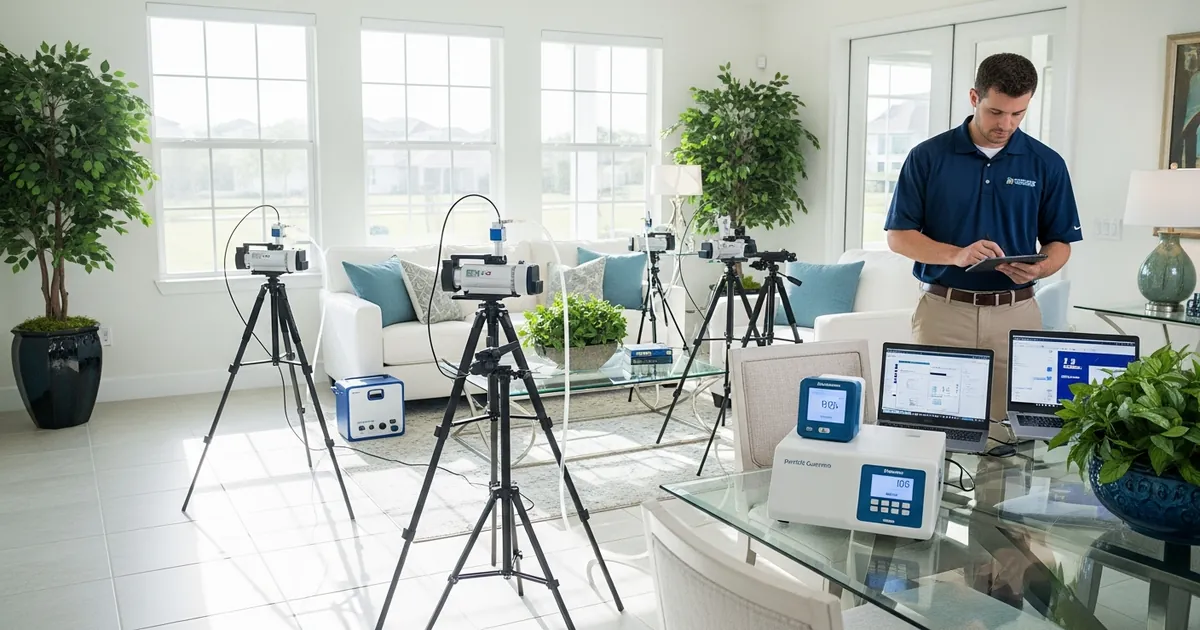
A professional IAQ test involves collecting air samples from multiple locations inside the home and at least one sample from outside for comparison. We use calibrated air sampling pumps that pull a measured volume of air through a collection cassette over a set period, typically five to ten minutes per sample. The cassettes are then sealed and sent to an accredited laboratory for analysis. The lab identifies and counts the mold spores present in each sample, broken down by genus: Aspergillus, Penicillium, Cladosporium, Stachybotrys, and others. They also measure total spore counts and compare indoor levels to outdoor baseline levels. In addition to mold spores, IAQ testing can measure volatile organic compounds, which are chemicals released by building materials, paints, cleaning products, and even furniture. Humidity and temperature are recorded at each sampling location because they directly affect both mold growth potential and occupant comfort. The result is a comprehensive snapshot of what your indoor air contains and how it compares to acceptable standards.
AIHA-accredited laboratories follow standardized protocols for mold spore identification and quantification, ensuring reliable and legally defensible results. → AIHA Laboratory Standards
How to Read Your Lab Results Without a PhD
When the lab results come back, typically within three to five business days, they tell a detailed story about your home's air. The most important comparison is indoor versus outdoor spore counts. Outdoor air always contains some level of mold spores, that's normal. What matters is whether your indoor levels are higher than outdoor levels and by how much. If indoor Aspergillus spore counts are five times higher than outdoor levels, there's an active source inside the home. If Stachybotrys is detected indoors at any level but not found outdoors, that's significant because Stachybotrys requires sustained water damage to grow and doesn't normally appear in outdoor air samples. The report also shows the diversity of species present. A home with one or two dominant species at elevated counts usually has a specific moisture problem in a specific location. A home with many species at moderately elevated counts might have a general humidity control issue. I walk every client through their results in plain language because the raw lab data can be intimidating if you've never seen it before.
What to Do With the Report: Actionable Next Steps
IAQ testing makes sense in several situations: when you or your family are experiencing unexplained respiratory symptoms, after any water damage event, before purchasing a home, after remediation work is completed to verify effectiveness, and whenever you notice musty odors or signs of moisture problems. In Florida specifically, I recommend periodic IAQ testing for any home that's more than ten years old, because the cumulative effect of our humidity on building materials creates conditions that gradually degrade indoor air quality even without a dramatic water event. At Mold Rid Of, indoor air quality testing is a core part of what we do. We hold MRSA License number 3958 and are IICRC certified. We perform assessment and inspection exclusively, never remediation, so our test results and recommendations are completely independent. Every sample we collect is analyzed by an accredited third-party laboratory, and every report we deliver includes clear explanations and actionable guidance. If you want to know what you're breathing inside your Florida home, call us at (786) 616-6307 or visit moldridof.com.
