How Fast Does Mold Grow After a Water Leak in Florida?
Florida Licensed Mold Assessor; MRSA #3958
How Fast Does Mold Really Grow in Florida? The Question With a Clock on It
A pipe bursts under your kitchen sink at 2 a.m. You mop up the water, set up a fan, and assume the problem is solved. But in Florida, what you cannot see is already happening: mold spores that were dormant on your drywall, wood framing, and carpet padding are now absorbing moisture and beginning to germinate. Within 24 hours, those spores will start producing thread-like structures called hyphae that penetrate building materials. Within 48 hours, visible colonies can appear. And within a week, mold can spread behind walls, under flooring, and into your HVAC system, turning a minor leak into a major remediation project. This timeline is not theoretical. It is based on the IICRC S500 Standard for Professional Water Damage Restoration and confirmed by thousands of inspections we have conducted across Florida. Understanding how fast mold grows after water damage is not just useful knowledge: it determines whether you spend $300 on testing or $15,000 on remediation.
The 24-48-72 Hour Growth Timeline Backed by IICRC S500
Mold does not appear overnight, but its development begins almost immediately. Here is the scientifically documented timeline that applies to Florida homes after a water leak, flood, or plumbing failure. During the first 0 to 12 hours, water is absorbed into porous building materials: drywall, wood, carpet, insulation, and ceiling tiles. Dormant mold spores already present on these surfaces begin absorbing moisture. There is no visible change, but the biological clock has started. Between 12 and 24 hours, spores begin germinating, extending microscopic hyphae into the material they are growing on. In Florida, where indoor humidity often sits between 60 and 75 percent even with air conditioning, this phase accelerates significantly. The material does not look or smell different yet. The 24 to 48 hour window is critical. Mold colonies begin forming on surfaces that remained wet. You may notice a faint musty odor before anything is visible. Drywall paper facing, carpet backing, and wood framing are the first materials colonized. At this stage, professional air sampling can detect elevated spore counts even when nothing is visible. Between 48 and 72 hours, mold becomes visible as dark spots on walls, discoloration on ceiling tiles, or fuzzy patches on baseboards. Multiple species may colonize simultaneously, with fast-growing species like Aspergillus and Penicillium appearing first, followed by Cladosporium and eventually Stachybotrys (black mold) in chronically wet areas. From 72 hours to 7 days, mold releases spores into the air, contaminating adjacent rooms through natural air circulation and HVAC systems. The colony expands behind walls, under flooring, and along plumbing lines. The scope of contamination can increase from a single wall to multiple rooms in under a week. Between 7 and 14 days, mold hyphae penetrate deep into wood framing, subfloor material, and insulation. At this stage, surface cleaning is insufficient. Materials may require removal and replacement, and professional remediation becomes necessary.
The IICRC S500 Standard for Professional Water Damage Restoration establishes that microbial amplification can begin within 24 to 48 hours of water intrusion if conditions are favorable. → IICRC S500 Standard
Florida-Specific Factors That Accelerate Colonization Past National Averages
The timeline above applies broadly, but Florida presents conditions that push mold growth toward the fastest end of every estimate. Understanding these factors explains why the 48-hour response window is not a suggestion: it is a deadline. Florida's average relative humidity ranges from 70 to 90 percent outdoors and 50 to 70 percent indoors (even with air conditioning). The EPA recommends keeping indoor humidity below 60 percent to inhibit mold growth. Many Florida homes exceed this threshold routinely, meaning mold spores never fully dehydrate: they are perpetually ready to activate when liquid water appears. Temperature is another major factor. Mold grows fastest between 77 and 86 degrees Fahrenheit. Florida's average indoor temperature falls squarely in this optimal range for 8 to 10 months of the year. Cooler climates may slow mold growth; Florida accelerates it. Florida construction commonly uses materials that mold consumes readily: paper-faced drywall, oriented strand board (OSB) sheathing, tack strips, and fiberglass-backed insulation. These organic materials provide both nutrition and a hospitable surface for mold colonization. Air conditioning systems in Florida run 10 to 14 hours per day during summer. Condensation on supply ducts, air handler coils, and ductwork creates persistent moisture zones that are invisible to homeowners but ideal for mold growth. A water leak near an HVAC intake can distribute spores throughout the entire home within hours. Many Florida homes are built on concrete slabs without crawl spaces. When water intrudes through a slab crack or under baseboards, it becomes trapped between the slab and flooring material with no natural evaporation path. This creates a sealed moisture chamber where mold thrives.
The EPA states that mold growth is accelerated when relative humidity exceeds 60 percent, a threshold routinely exceeded in Florida homes during summer months. → EPA Mold Resources
The Early Warning Signs of Active Mold in the First Week
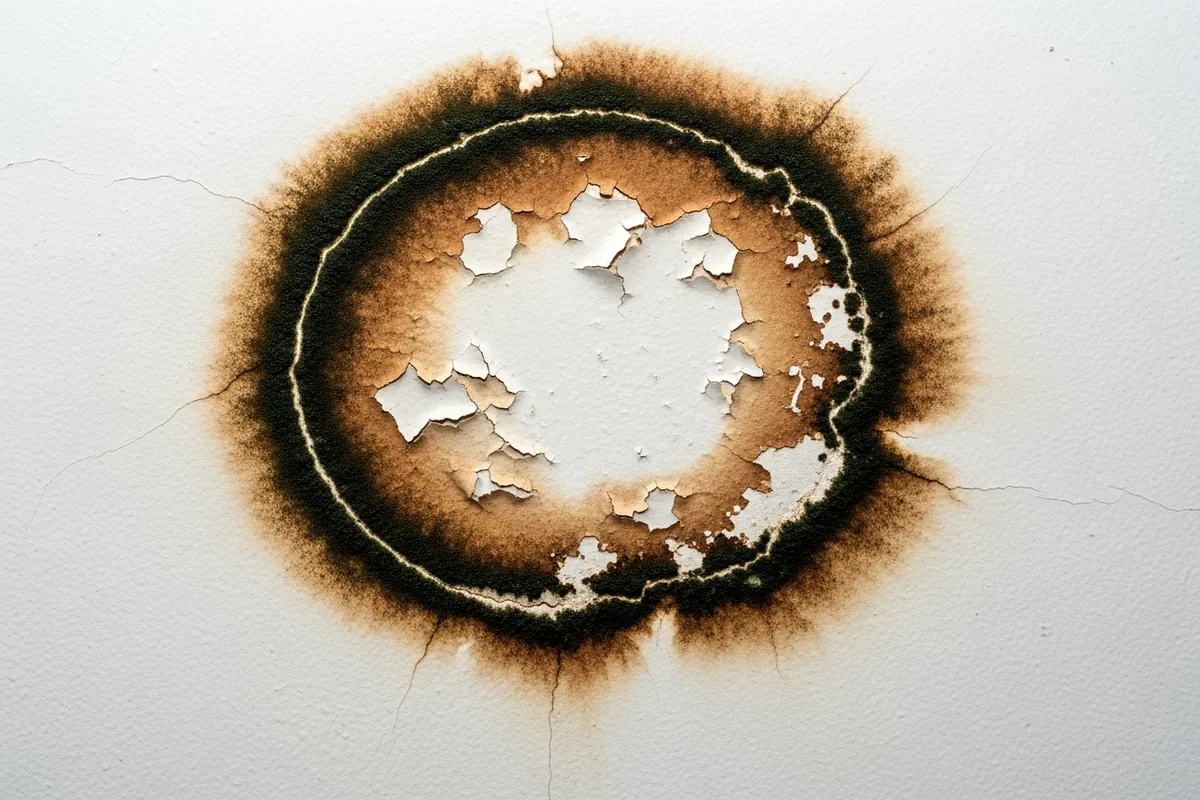
After a water leak, watch for these indicators that mold growth has begun, even before colonies are visible. The distinctive musty or earthy smell of mold often appears 24 to 48 hours before any visible growth. If you notice this smell after a water event, mold colonies are forming somewhere in the affected area, possibly behind walls or under flooring where you cannot see them. If an area that was water-damaged still feels damp or humid 24 hours after cleanup, residual moisture is likely trapped in wall cavities, subfloor material, or insulation. A professional moisture meter or thermal camera can confirm whether hidden moisture remains. Watch baseboards, ceiling tiles, drywall seams, and window frames for subtle color changes: yellowing, darkening, or spotting. These early stains often indicate mold colonization beginning on the back side of the material. Occupants may experience increased sneezing, nasal congestion, eye irritation, or headaches within days of a water event. These symptoms can indicate elevated airborne spore counts from active mold growth, even when no mold is visible. When moisture becomes trapped behind a painted surface, the paint may begin to bubble, crack, or peel. This is a strong indicator that the material behind the paint is wet enough to support mold growth.
Your First 48 Hours Action Plan After a Water Leak
The actions you take in the first 48 hours after discovering a water leak determine whether mold becomes a minor inconvenience or a major remediation project. Here is the step-by-step response protocol we recommend to every Florida homeowner. In the first 0 to 2 hours, stop the water. Turn off the water supply, contain the leak, or call an emergency plumber. Every additional hour of active water flow increases the affected area exponentially. In hours 0 to 4, remove standing water. Extract standing water using wet vacuums, towels, or mops. Move furniture and personal items away from the affected area. Remove area rugs and lift carpet edges to allow subfloor drying. In hours 0 to 6, maximize air circulation. Run fans, dehumidifiers, and your HVAC system to begin drying. Open cabinet doors and closets near the leak. If weather permits, open windows to improve air exchange. Target indoor humidity below 50 percent. Between hours 2 and 24, document everything. Photograph the water damage from multiple angles. Document the source of the leak, the extent of water spread, and every material that got wet. This documentation is critical for both insurance claims and any future mold assessment. Between hours 24 and 48, schedule a professional assessment. If any materials remained wet for more than 24 hours, or if you detect a musty odor, schedule a professional mold assessment immediately. Our licensed MRSA assessors use FLIR thermal imaging to detect moisture trapped behind walls and air sampling to establish baseline spore counts. This 48-hour window is your best opportunity to catch mold before it establishes deep colonies. Call Mold Rid Of at (786) 616-6307 for same-day assessment throughout Miami, Orlando, Tampa, and Fort Lauderdale. Operating under Florida DBPR Mold Assessor License MRSA3958, we provide independent, conflict-free evaluations. We do not perform remediation, so our findings are objective and designed for review by insurance carriers, lenders, title companies, or adjusters.
Florida Statutes Chapter 468.8419 requires that mold assessment and remediation be performed by separate licensed entities, ensuring independent documentation of water damage and mold contamination. → Florida Statutes Chapter 468
Frequently Asked Questions
How fast does mold grow after a water leak?
In Florida's climate, mold spores can begin germinating within 24 hours of water exposure. Visible colonies typically appear within 48 to 72 hours. Within 7 to 10 days, mold can spread behind walls, under flooring, and into HVAC systems if the moisture source is not eliminated.
Can mold grow in 12 hours?
While spore germination can begin in as few as 12 hours under ideal conditions (warm temperatures, high humidity, organic material), visible mold colonies generally require 24 to 48 hours to develop. In Florida, where ambient humidity often exceeds 70 percent, the germination process is faster than in drier climates.
Should I get a mold test after a water leak?
Yes. Even if you dried the area quickly, moisture can become trapped behind walls, under baseboards, and in subfloor material. A professional mold assessment with thermal imaging and air sampling can detect hidden moisture and early-stage mold growth that is invisible to the naked eye. Testing within 3 to 5 days of the leak provides the most accurate baseline.
Does homeowner insurance cover mold from a water leak?
Many Florida homeowner policies cover mold damage if it resulted from a sudden and accidental covered peril (such as a burst pipe). However, mold from long-term neglected leaks or maintenance issues is typically excluded. A licensed mold assessment report provides the documentation insurance adjusters require to process your claim.
