How to Send the Florida 7-Day Notice for Mold Under Statute 83.56
Florida Licensed Mold Assessor; MRSA #3958
The 7-Day Notice: Florida's Most Underused Tenant Tool for Mold
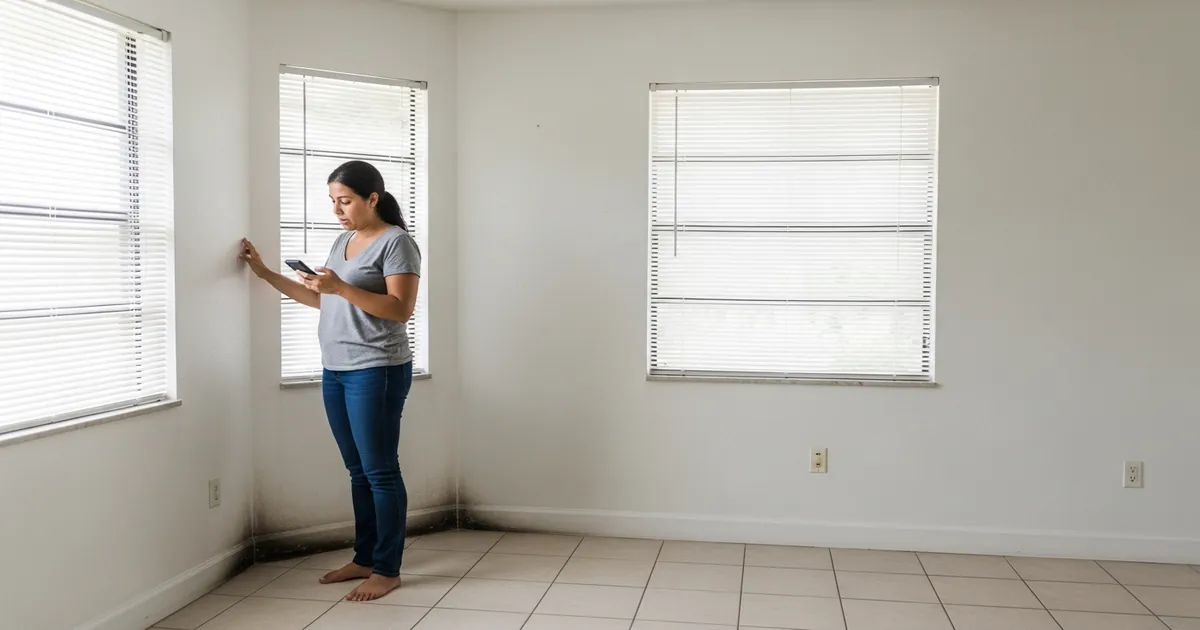
When mold appears in a Florida rental and the landlord is slow to act or outright unresponsive, tenants have a specific legal tool written directly into state law: the 7-day notice under Florida Statute 83.56. The notice is not a lawsuit, not an eviction filing, and not a complaint to code enforcement. It is a formal written demand that the landlord cure a material habitability defect within 7 days or face statutory consequences, including the tenant's right to terminate the lease, withhold rent, or sue for damages. Mold Rid Of has guided dozens of Florida tenants through this process after a Florida DBPR-licensed mold assessment revealed contamination the landlord refused to address. The notice works, but only if it is delivered correctly, documented thoroughly, and backed by real evidence. This article walks through exactly how Florida tenants use the 7-day notice for mold: what triggers it, what it must say, how to deliver it, and what an independent mold assessment adds to the record. Skip any of the procedural requirements and the landlord can ignore the notice with no statutory consequence. Follow them, and you have a powerful tool that Florida courts take seriously.
What Florida Statute 83.56 Actually Says About Habitability and Notice
Florida Statute 83.56(1) is the specific provision that creates the 7-day notice right. The statute reads that if a landlord materially fails to comply with Statute 83.51(1), which is the landlord's duty to maintain the premises in compliance with building, housing, and health codes, the tenant may deliver a written notice specifying the noncompliance and demanding correction within 7 days. Mold is not mentioned by name in Chapter 83, but Florida courts have consistently held that visible mold growth caused by a landlord-responsibility moisture source (plumbing, roof, HVAC, structural) qualifies as a condition that materially affects health and violates applicable codes. The key statutory requirements are three: the noncompliance must be 'material' (not a minor issue), the notice must be 'written' (verbal complaints do not trigger statutory rights), and the cure period is exactly 7 days from delivery. Getting any of these three wrong is the most common reason Florida tenants lose the protection of this statute when they later try to enforce it.
Florida Statute 83.56 outlines the tenant's right to deliver written notice requiring the landlord to remedy conditions that materially affect health or safety within 7 days. → Florida Statutes 83.56
How to Write the 7-Day Notice That Survives a Landlord Dispute
The notice itself must include specific elements to satisfy the statute. First, the tenant's full name and the rental address. Second, the landlord's name and the address where rent is paid (Florida Statute 83.50 requires the landlord to provide this). Third, a clear description of the mold condition: where it is visible, what symptoms are occurring, and when the tenant first reported the underlying moisture source. Fourth, an explicit demand to cure the condition within 7 days. Fifth, a statement that if the landlord fails to cure, the tenant intends to exercise remedies under Florida Statute 83.56, which may include lease termination or rent withholding. Sixth, the date of the notice and the tenant's signature. Template language that works: 'Pursuant to Florida Statute 83.56(1), I hereby provide written notice that the following condition at [address] materially violates the landlord's obligations under Florida Statute 83.51(1): visible mold growth in [location] caused by [moisture source], first reported to you on [date]. I demand that this condition be cured within 7 days of your receipt of this notice. If the condition is not cured within 7 days, I intend to exercise all remedies available under Florida Statute 83.56, including termination of the lease or withholding of rent in proportion to the diminution of rental value. Signed, [tenant name], [date].' Keep a dated copy before delivery.
Delivery Methods: Certified Mail, Hand Delivery, and the Documentation That Matters
Delivery is where most Florida tenants lose their statutory protection. The notice must actually reach the landlord, and the tenant must be able to prove it. Florida law allows three delivery methods: hand delivery, certified U.S. mail with return receipt, or posting on the premises. The safest method by far is certified mail with return receipt, because it creates an undisputed paper trail: the tenant keeps the green receipt card signed by the landlord, plus the original mailing receipt. If the landlord refuses to accept the certified mail, the postal service notation of refusal still constitutes legal delivery. Hand delivery requires a witness, preferably a non-family adult who can sign a dated statement confirming the delivery. Email and text message alone are not sufficient under the statute, though they are useful as a supplement to certified mail. The 7-day clock starts on the date of actual delivery (for certified mail, the date on the return receipt or the date of attempted delivery if refused). Keep every document, every receipt, every photograph, and every timestamped email in a single folder. If the landlord later disputes that the notice was delivered, this folder is your evidence.
The Two Remedies After the 7 Days Expire: Termination or Proportional Withholding
After the 7-day cure period expires without the landlord correcting the condition, Florida Statute 83.56(1)(a) and (b) give the tenant two primary remedies. The termination remedy allows the tenant to vacate immediately after the 7 days end, terminate the lease with no early-termination penalty, and demand return of the full security deposit and any prepaid rent. The withholding remedy allows the tenant to stay in the unit and reduce rent 'in proportion to the reduced rental value' of the mold-affected space. If half the unit is unusable, half the rent may reasonably be withheld. Both remedies require the original notice to have been properly worded, delivered, and documented. If the landlord later files an eviction action for nonpayment, the tenant must be prepared to defend with a copy of the notice, proof of delivery, evidence of the unremedied condition, and ideally a licensed MRSA assessment report. Florida courts also allow tenants to pursue damages for the diminished use of the property, costs of relocation, and in some cases, attorney fees if the landlord acted in bad faith. The 7-day notice is the gateway to all of these remedies.
Florida Statute 83.51 establishes the landlord's obligation to maintain rental premises in compliance with building, housing, and health codes. → Florida Statutes 83.51
Why an Independent MRSA Assessment Turns Complaint Into Evidence
The single most effective way to strengthen a Florida 7-day mold notice is to attach an independent licensed MRSA assessment report. A subjective complaint of 'I smell mold' or 'there is mold in my apartment' is legally weak because it is unverifiable. A licensed MRSA #3958 assessment report with species identification, spore counts from an AIHA-accredited laboratory, moisture mapping, and documentation of the moisture source transforms the notice from an accusation into documented evidence. Florida courts and landlords both take a Mold Rid Of report seriously because it is independent (we do not perform remediation under Florida Statute 468.8419), scientifically defensible, and admissible as expert evidence. The cost of the assessment, typically $249.99 to $549, is often recoverable as damages if the landlord disputes the notice and forces the tenant into court. For Florida tenants facing an unresponsive landlord over mold, the sequence is clear: document the condition with photographs, order an independent MRSA assessment, attach the report to a properly-worded 7-day notice, deliver by certified mail, and keep everything in writing. This sequence protects the tenant's statutory rights and makes subsequent legal remedies enforceable. Call Mold Rid Of at (786) 616-6307 for a free consultation on whether your situation warrants an assessment, and we will tell you honestly based on your specific facts.
Frequently Asked Questions
What is the Florida 7-day notice for mold?
The Florida 7-day notice is a written notification from a tenant to a landlord, authorized by Florida Statute 83.56(1), demanding that the landlord cure a condition that materially affects health or safety within 7 days of delivery. Mold caused by a covered moisture defect (plumbing leak, roof failure, HVAC condensation, structural intrusion) typically qualifies. The notice must state the noncompliance with specificity, demand cure, and be delivered in a way you can prove.
Does mold automatically qualify as a 7-day notice condition?
Not automatically. The statute refers to conditions that 'materially affect health or safety' and violate building, housing, or health codes. Visible mold growth in occupied living space driven by a landlord-responsibility moisture source generally qualifies. Minor surface mold caused by tenant behavior (blocked vents, no AC use, condensation from showers without fan use) may not qualify. An independent MRSA assessment that identifies the moisture source is the single strongest piece of evidence for the notice.
How do I deliver the 7-day notice in Florida?
Florida Statute 83.40-83.683 allows delivery by mail, hand delivery, or posting on the premises, but the cleanest method is certified U.S. mail with return receipt, plus keeping a photographed copy of the notice and envelope. Email and text alone are risky because proof of receipt can be disputed. Always keep a dated copy of the notice, the certified mail receipt, and the return receipt card together with your photo documentation of the mold itself.
What happens if the landlord ignores the 7-day notice?
If the landlord does not cure within 7 days, Florida Statute 83.56(1)(a) and (b) give the tenant two primary options: terminate the lease and vacate without penalty, or withhold rent in proportion to the reduced rental value until the condition is cured. Both options require the original written notice to be properly delivered and documented. Withholding rent carries specific risks and usually requires depositing rent into the court registry if the landlord files for eviction.
Why do I need an independent mold assessment for the 7-day notice?
Because the notice has to state the noncompliance with specificity, and 'there is mold in my apartment' is not specific enough to survive a landlord dispute. A licensed MRSA #3958 assessment report documents the location, species, spore count, and moisture source of the mold. That report turns 'I think there is mold' into 'air sampling on April 10 showed 2,400 spores per cubic meter of Stachybotrys, with moisture mapping confirming a leak at the bathroom plumbing stack.' Courts take the second version seriously.
